Welcome to the Website for the “Ancient DNA Data Analysis” workshop.
Technical prerequisites
Our interactive exercises require a mix of tools, such as R, samtools, Eigensoft and Poseidon.
If you are an attendee of this workshop, you will have access to a prepared RStudio-Cloud environment which has all that you need ready to go. The only thing you will need is a webbrowser and an RStudio-Cloud account, see below.
RStudio-Cloud
Our interactive exercises are done in RStudio-Cloud.
In order to join our “classroom” workspace, you need to follow this link. Then follow these steps:
- Click on “Sign up” to create a free account, or, if you already have an account, simply log in
- In the workshop space, you should now see “Join Space?” -> Click “YES”
- In the top menu, click on “Projects”
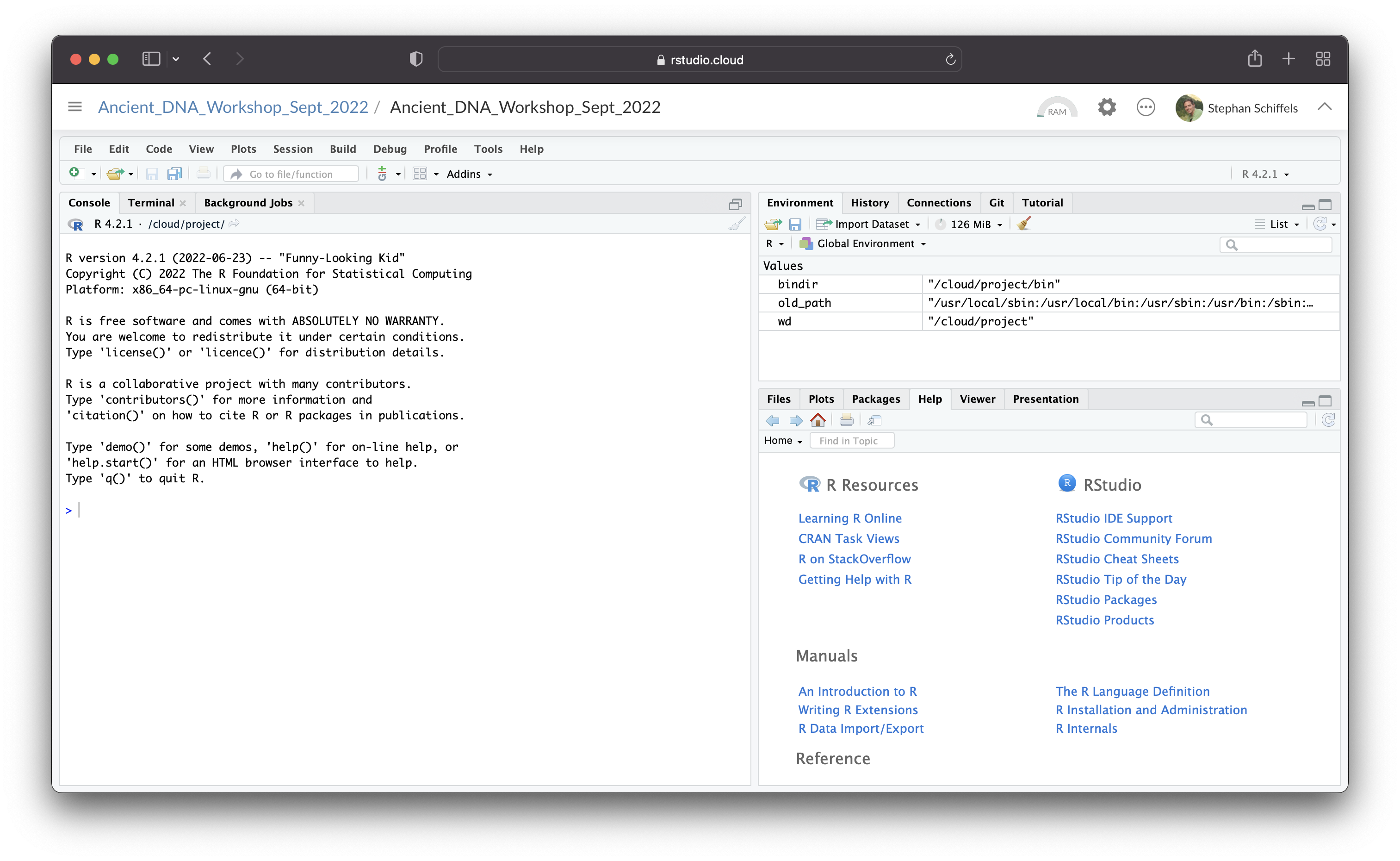
- You should see a project named “Ancient_DNA_Workshop_Sept_2022”. Click on “Start” right next to it.
- You should now see something like this:
Schedule
Day 1, Tue, Sept 6
| Time | Activity |
|---|---|
| 13:30 - 15:00 | Introduction |
| 15:00 - 15:30 | Coffee break |
| 16:00 - 18:00 | Part 1: Sequencing Data |
Day 2, Wed, Sept 7
| Time | Activity |
|---|---|
| 08:30 - 9:30 | Part 2: Neandertals and ghosts |
| 9:30 - 10:00 | Coffee break |
| 10:00 - 12:00 | Part 2: Neandertals and ghosts (cont.) |
| 12:00 - 13:00 | Lunch break |
| 13:00 - 15:00 | Part 3: Human history during the last 10,000 years |
Exercises
- Exercise 1.1: Alignment
- Exercise 1.2: Visualising BAM files
- Exercise 1.3: Genetic sex determination
- Exercise 2.1: Neandertal admixture in modern humans
- Exercise 3.1: Recent human population structure
Solutions
Instructor
Stephan Schiffels is a group leader at the Max Planck Institute for Evolutionary Anthropology in Leipzig, Germany. He has originally studied physics and obtained his PhD in 2011. He worked as a Postdoc at the Wellcome Trust Sanger Institute in Hinxton, UK and since 2015 as a group leader at the Max Planck Institute. His research interests range from theoretical population genetics, statistical and bioinformatic method development, to large-scale archaeogenetic studies to investigate the human past.